Complexation of Tl+ by NO2-
This example is taken from Calculating Equilibrium Concentrations by the Continuation
Method, D. P. Cobranchi and E. M. Eyring, Journal of Chemical Education, 68,
40-41, 1991. The authors used the example in a first-year graduate course in
analytical chemistry. The problem involves determining the species
distribution resulting from the complexation of Tl+ by NO2-
in aqueous solution which is 10-3 M in total thallium and in
total nitrite species. The authors quote the five equilibria:
H+(aq) + NO2-(aq)
= HNO2(aq); log10(K1) = 3.15
HNO2(aq) + H+(aq) = NO+(aq) + H2O(aq);
log10(K2) = -8.10
2HNO2(aq) = N2O3(aq) + H2O; log10(K3)
= -0.80
Tl+(aq) + NO2-(aq) = TlNO2(aq);
log10(K4) = 0.85
H2O = H+(aq) + OH-; log10(K5)
= -14.
Cobranchi and Eyring transformed the problem by hand into one involving a pair of quintic equations, and used a FORTRAN-IV program to solve them. This problem results in a total of 25 roots, from which the physical solution must be extracted. The computation required 25 minutes on an IBM PC/AT.
EQS4WIN directly and rapidly solves the original problem. Furthermore, it can interactly explore variations in problem parameters. This problem is included as an example in all versions of EQS4WIN. It is an example of the use of Reaction Input Data.
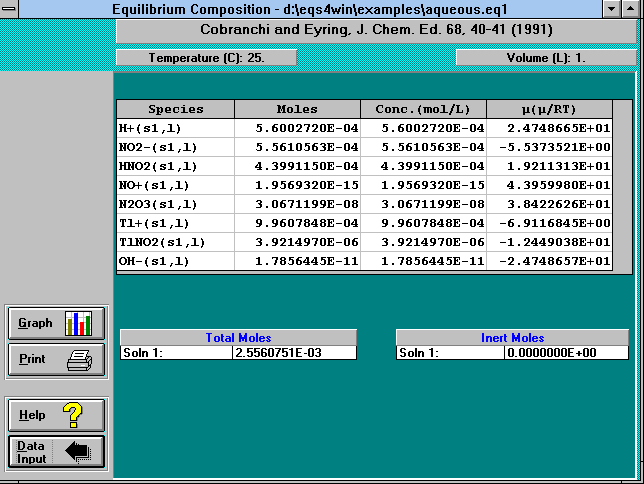
Click on image to enlarge (16.2K)